Bukalapak had a model that worked for warung owners in Indonesia. SmartSari was the bet it could work in the Philippines too. As a founding designer, I defined the localization strategy, the unique selling point, and the MVP that took it from zero into a new market, and into $144K of GMV in its first month.
Localization is not translation. Real localization weighs context, culture, and emotion, not just language.
Bukalapak was exploring regional expansion to reach underserved MSMEs across Southeast Asia, and SmartSari was the first move: a product localized for the Philippines. The Mitra Bukalapak product had matured in Indonesia, but a new market with different languages, cultures, payment habits, and levels of trust in online transactions meant we couldn't port it. We had to rethink the approach from the ground up.
The goal was a localization strategy built specifically for the Philippines, not a translated copy of the Indonesian app. That broke into a few concrete jobs:
- Find and sharpen the USP: identify what SmartSari uniquely offered Filipino sari-sari owners, and say it clearly.
- Ship a real MVP: deliver designs across both mobile and web, fast.
- Make it scalable: leave behind guidelines so the next market wouldn't start from zero.
I joined as an individual contributor trusted to be a founding member, working closely with product, engineering, research, and business. I led the effort to define the USP, the MVP scope, and the long-term design vision, and I helped onboard new designers as the team grew from three to ten across functions.
- Research: studied market behavior and the competitor landscape in the Philippines, ran user interviews across countries, mapped payment preferences, and aligned cross-functional stakeholders on positioning and the USP.
- Scope: led USP and scoping brainstorms across four countries (Indonesia, Singapore, the Philippines, and Australia) that translated business objectives into a lean, scalable MVP, and defined design principles and an information architecture that could adapt to other SEA markets.
- Build: delivered wireframes, high-fidelity mockups, and a design-system foundation, plus a localization playbook covering tone, terminology, cultural nuance, and UI adaptations.
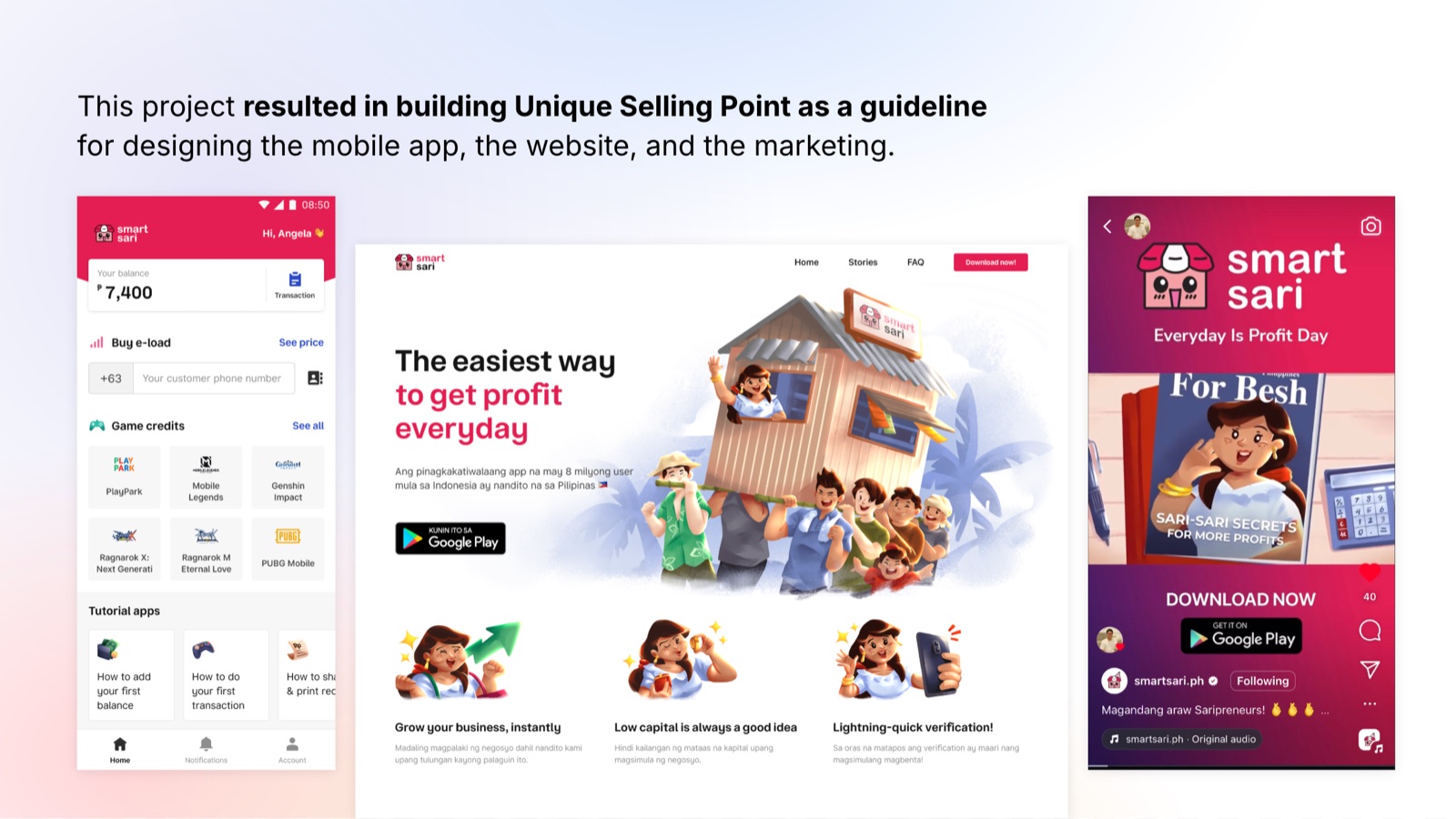
SmartSari launched for the Philippine market with localized UX across mobile and web. In its first month it drove over $144K in transactions, and the localized flow cut drop-off at the payment step. The USP became the reference point for branding, marketing, and onboarding, and the localization playbook was reused for early exploration in other Southeast Asian countries. The launch validated product-market fit and laid the groundwork for everything that came after. The deeper lesson: the product doesn't transfer to a new market, but why people love it does. So we stopped competing on the wallet and carried the emotional truth: grow your store and your life.